Pages

Showing posts with label Reading. Show all posts

Monday, February 16, 2015

Reading Along with the Global Read Aloud (Part I)

I was so excited this year when all four 6th grade Language Arts teachers agreed to give the Global Read Aloud a chance! It wasn't a hard sell since One for the Murphy's by Lynda Mullaly Hunt is a fantastic text. But I was nervous. I hadn't ever participated in the Global Read Aloud before and now four classroom teachers were depending on me to lead them through this new experience.

Not heard of the Global Read Aloud? It is a great global project where Pernille Ripp (GRA creator) chooses a few books that would appeal to students K-8 (and even older) and teachers agree to read one of the books (or collection of books) over a set period of time. Then, teachers can connect with each other through Skype, Twitter, Edmodo, Padlet, Kidblog, or whatever tool seems best suited for the teacher and the learners. Part of the magic of the project is that teachers can decided how involved to get. They can just read the book or they can host Twitter slow chats while Skyping their Kidblog posts! Ok, that last example might be a little much.

As a newbie to the Global Read Aloud, I wasn't sure what techniques would be the most effective or which technologies would have the biggest impact. Here are a few things we tried and how they went.

Mystery Skype


We launched the Global Read Aloud with Mystery Skype sessions with four different schools (not familiar with Mystery Skype? Read more here: Who Doesn't Love a Mystery?). Students had already done some Mystery Skyping in their social studies class so they were excited to do it again and to meet other students that would be reading the book along with them.

Edmodo


Next we created Edmodo accounts for all of the students to post reflections about the text and to share their thoughts with schools in TX, OK, NC and LA. Edmodo was a struggle for us. Our students had trouble logging on and remembering their login information. And sometimes, they got a little too silly in Edmodo and forgot that it was a space for educational conversation and not just socializing. I think we'll try Edmodo again later in the year with some adjustments for our Special Education students and English Language Learners. I was proud of the students that took it seriously though and like the following activities that we tried:
  • Reading the "blurb" on the back of the book, do you think this book will have internal or external conflicts? Explain your answer.
  • After reading a few chapters, what kinds of conflicts have there been so far in the book, external or internal. Explain your answer.
  • List character traits of a character without saying which character you are describing. (Other students then guessed which character.)
Even though we struggled with the management aspect of Edmodo, I was thrilled that students had a chance to interact with each other, engage in meaningful writing and see the writing of their peers (especially important for our Special Education students and English Language Learners).

Powerpoint


I know, PowerPoint? Yes, PowerPoint. The teachers and I made PowerPoints for each chapter that contained key images from the novel. The purpose of these PowerPoints were two-fold. (1) We chose images of vocabulary we weren't sure our students were familiar with. This might have been home-made lasagna, scenes from Wicked, or Elvis impersonators.  (2) By projecting these images during the read aloud, students began to anticipate and predict aspects of the text. Teachers shared that this led to more engaged and meaningful reading. So, yes, PowerPoint. *grin*

Twitter


One of our highlights was when I tweeted drawings the students had done based on figurative language (by the way, if you are looking for an excellent text full of figurative language, One for the Murphy's is a great find). I would post the student's drawing along with the phrase it was based on and mentioned Lynda Mullaly Hunt. And she replied!!! Right away!!! I took a screenshot of the exchange and shared it with the students the next day. One of the boys' whose picture had gotten a reply could barely contain himself. He stood up, backed away from his chair and said "I need a minute." They were so excited that the ACTUAL AUTHOR had seen their work. This was a huge moment for these sixth graders.

Skype conclusion


The other most memorable moment of the Global Read Aloud for me was when we had concluding Skype calls with our partner classrooms. Students in both classes wrote letters as the main character or wrote epilogues or characters sketches. During the Skype call, students from each class went up to the microphone and camera and shared their work. Seeing our students who struggle to be successful in their own school, in a new-to-them language, proudly reading their writing to students in Texas and hearing compliments from the other class was momentous. I know that those students will remember that moment for a long time.

So, if you haven't joined the Global Read Aloud yet, please consider doing so for next year. It will move you beyond the walls of your classroom and school and give your students a multitude of opportunities to engage in authentic writing. If you aren't sure which technologies suit you, just try a few.

If you are an experienced Global Read Aloud participant, please share your own successes (and challenges). I'd love to learn more as I hope to get more classrooms engaged next year and beyond!

Wednesday, March 26, 2014

Look! We got Nooks!

More and more eReaders are becoming the go-to devices for readers everywhere. We love the ability to carry 50 books at time with us on the airplane, to never lose our place because our bookmark fell out and to search names of characters to find when they were first introduced. That is why I was so excited when the English Language Arts department at the school where I worked decided to buy Nooks!
We decided to launch the Nooks in a 6th grade co-taught classroom. A number of the students in the class have Individualized Education Programs and many do not think of themselves as readers. Our goals were to get the students more excited about reading and to choose books that closely match students' lexiles (reading levels).
Our first day in the class, the reaction was more than positive. Students loved the layout of the device and had fun discovering all the features available to them. We all love to personalize our devices and Nooks are no different. Students learned (and taught each other) how to change the background image, adjust the font size to suit them and even adjust the orientation to the style they liked best. The ability to make a book their own was a new experience, and it makes a difference, having a book that you can change and modify increases student ownership in the device and increases their interest in reading the text.
Beyond the personalization of Nooks, students were able to practice a number of different during reading strategies. Students can highlight passages that they find significant, much the way readers in a book club will underline sections they want to share of come back to. Students can also use the embedded dictionary to look up words they don't know. For reluctant readers, the ability to find out the definition of new words without asking the teacher or physically using a dictionary (and thus showing the whole class you don't know the word) is a gift. Watching the students read on their Nooks, you can see them smoothly using all these techniques and empowering themselves to be better readers.
As this first class tests out the Nooks and we see the progress they are making, we look forward to expanding the use of the Nooks to more classes and for more novels. Students will be able to check out eBooks from the school library and the public library. We will be able to load novels that specifically match individual student lexile levels and increase their access to non-fiction texts. As we move forward, these devices will continue to give students access to relevant devices, literacy skills and personalized details which increases their interest and engagement with a wide variety of texts.

Wednesday, May 1, 2013

Website of the Week: ZooBurst

Easily create your own 3D pop-up book, great for lots of uses. The site is free, but requires an email address for registration.

The books are super easy to create, can include a mix of pictures and text. Pictures can be imported from your computer so you can use your own pictures or download pictures from the internet. When you create a book the owner can specify the privacy settings. See the Zooburst gallery for some interesting examples.

I have already had teachers try this format for Science presentations on how the sun creates energy, I could also see using it to:
1) Tell a fractured fairy tale in Language Arts
2) Detail the life of a famous figure from History
3) Give a tour of a cultural region in a World Language class
4) Have English Language Learners tell a story using new vocabulary words.

Wednesday, March 13, 2013

Website of the Week - Voki

http://www.voki.com/
Create an animated avatar that speaks, create a customized avatar that uses text-to-speech to say what you write. Vokis can be embedded in Blogs, wikis and websites.

http://www.voki.com/

Ideas for the classroom:

1) In History, research a famous historical figure: have them "saying" a famous quote.
2) In Language Arts, create a voki for a character in a novel. Have them "saying" a line of dialogue.
3) In World Language, have students introduce themselves in the target language
4) In Math, have students define mathematical terms.
5) In Science, have vokis report the results of a lab.

For more ideas, check out: Voki Lesson Plans

Wednesday, February 20, 2013

Students Use Phones to Record Lit Circles!

This is one of those ideas that is so good, I wish I had thought of it:

Have your students use their phones to record their Literature Circle Discussions!

The other day I walked into Ms. Z's room for a meeting on another topic but the first thing she shared was the idea above. She was so excited! Having spent years developing different routines and procedures for Literature Circles (or Book Club Meetings as she calls them), she had never been satisfied with how she was assessing student participation in discussion. She described past lessons where she made herself crazy trying to dip in and out of each group's meeting, manically scribbling student quotes, dashing down notes, and completing checklists. It was stressful and an incomplete pictures of how the book clubs were doing.

On this day, she told each group to take out a cell phone and record their meeting. At the end of class, each group was to email her the file of their discussion. Voila! A simple solution for holding each group accountable for their meeting ("Don't say that, this is getting recorded!") and for her to listen more deeply in class ("I could sit and really listen to the meeting.") and for her to follow up on individual contributions (Ms. Z could listen to the meetings later in the day and give specific feedback to students about their role in the group). What a difference.

What I love about this idea is that:
  • it is simple - record the meeting, email the teacher
  • it uses technology that students already have with them (even in our very economically diverse middle school, there was at least one cell phone per group)
  • it puts responsibility on the students (Ms. Z reports that students were even more on task than usual, knowing their discussion was being recorded)
  • it amplified the teacher's ability to give feedback to students (she could now be in more than one place at a time!) 
I'd love to hear from others what they think about this strategy. Have you already been doing this? What makes it work well? What challenges have you faced? How has administration responded? Students? Parents? Can you think of other times it's useful to have students use their cell phones to record? Please leave a comment and let me know what you think!

Monday, November 19, 2012

Launching a Virtual Book Club

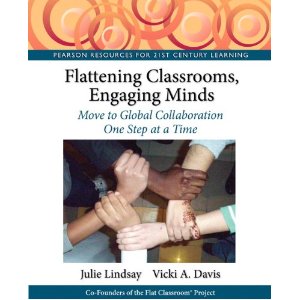
I am giddy with excitement about the opportunity to host a Virtual Book Club discussing the fantastic book Flattening Classrooms, Engaging Minds: Move to Global Collaboration One Step at a Time by Julie Lindsay and Vicki A. Davis. The book club was announced last Sunday night in my school division and I am thrilled that we already have thirteen teachers signed up! Even better, we have teachers from across our school division and from all different grade levels. It is a wonderful thing when already busy teachers find time in their lives to discuss powerful educational ideas with their peers. 

Now, I am ready to get some global participation in this book club. I can't think of a better way to brainstorm about global projects than to have teachers from across the globe in the session together. So, we are inviting all teachers, parents, students, thinkers and learners out there to join us for six live meetings to share what they think about the projects, resources, and research discussed in Flattening Classrooms, Engaging Minds.

We will be meeting on Tuesdays at 00:30GMT (Mondays at 7:30pm EST)

(find the time in your country/time zone here)

on the following dates:

January 7th - Meet the Flat Classroom, Chapters 1 & 2

January 21st - Connection and Communication, Chapters 3 & 4

February 4th - Citizenship, Contribution and Collaboration, Chapters 5 & 6

February 18th - Choice and Creation, Chapters 7 & 8

March 4th - Celebrating, Designing, Managing a Global Project, Chapters 9 & 10

March 18th - Rock the World


Meetings will be live using Blackboard Collaborate and will last one hour. We will spend the time sharing thoughts about ideas raised in the book. It will also be a great opportunity to connect with other educators that share similar passions and beliefs about flattening our classrooms walls. We will share strategies and resources for building those 21st century skills like collaboration, communication and creativity in authentic ways.

Inspiration for this Virtual Book Club came from Julie Lindsay and Vicki Davis themselves. I was lucky enough to participate in a Virtual Book Club hosted by Engaging Educators last spring. It was great because I
  • actually read the book (instead of the book just staring at me from my book shelf, desperate to be read but collecting dust instead)
  • met educators from across the United States and around the world
  • learned about global projects that already exist that I could participate in
  • was inspired to do more to help students and teachers connect and collaborate
I hope that you can take some time to read the book and join us for our discussions. If you are interested, please complete this quick form so that I know you are interested and I'll get back to you with information about our first meeting. And, please, spread the word!

If you aren't familiar with the idea of a virtual book club or with this text, here's more!

What is a Virtual Book Club?

A virtual book club is one in which readers come together to discuss a text using a web-based platform. Readers connect by logging onto a website in which they can be active learners and collaborators. The virtual room allows readers to speak, listen, chat and read about what others think about the text. All participants need is a web link, a computer with access to the Internet (and preferably a working microphone) and thoughts and ideas about the reading. It is like a book club but you can stay home and be in your pajamas!

What book will we be reading?

We will be reading the text Flattening Classrooms, Engaging Minds by Julie Lindsay and Vicki Davis. This book is co-written by classroom teachers that have transformed learning in their classrooms by communicating and collaborating with other classrooms around the world. Learn more about how global learning provides authentic literacy experiences, gets students engaged in their learning and opens up numerous opportunities for differentiation.


Tuesday, May 22, 2012

4tVirtual Con Adventures with Digital Reading/Writing Workshop

In addition to collaborating and presenting on The Global Classroom Project (Teachers Teaching Teachers About Global Projects) I was lucky enough to pull together four amazing Language Arts/English teachers to share their experiments and adventures with Digital Reading/Writing Workshop at the 4tVirtualCon. If you've read some of my other posts: Dude, Can You Please Edit and We Have Authentic Voices, you know that one of my passions is using digital tools to give students authentic opportunities to write and to reflect on what they've read. These four teachers are doing it and shared their ideas in this presentation.


I wanted to use this post to share their amazing work. They were all generous enough to also share some hand-outs they use and resources they found helpful. If you have additional resources or if you've blogged about similar topics, please comment here and add your own ideas, links or questions!


Here is a link to the slides from the presentation: http://www.slideshare.net/edtechdunny/dude-canyoupleaseeditss


Read more about "The Students Take Control: Virtual Literature Circles" here: http://elenagreertlpproject2012.weebly.com/index.html


Plus, read this article from Educational Leadershiphttp://www.educationalleadership-digital.com/educationalleadership/201009?pg=52&pm=2&u1=texterity#pg52 


Read and listen to middle and high school students publishing their work: http://authentic-voices.wikispaces.com/


Resources for trying out character blogs: https://www.dropbox.com/sh/dyiohc9mix4u5or/MZOcLxZON_


Plus this great post from Read, Write, Think: http://www.readwritethink.org/classroom-resources/lesson-plans/creating-character-blogs-1169.html 


Highly recommended reads:


The Digital Writing Workshop by Troy Hicks
Because Digital Writing Matters by National Writing Project, with Dànielle Nicole DeVoss, Elyse Eidman-Aadahl, and Troy Hicks


And, here is the link to our presentation:  https://sas.elluminate.com/p.jnlp?psid=2012-05-22.1458.M.86D4BB880224F640E9607ED9214AC7.vcr&sid=2009317


Thursday, November 24, 2011

Making Connections: Reading Aloud with a Purpose


Why create a Digital Talking Library?
“The single most important activity for building the knowledge required for eventual success in reading is reading aloud to children.” -- Richard C. Anderson, Elfrieda H. Hiebert, Judith A. Scott, Ian A.G. Wilkinson, Becoming a Nation of Readers: The Report of the Commission on Reading (Champaign-Urbana, IL: Center for the Study of Reading, 1985), p. 23.
This is striking isn’t it? Read it again. Reading aloud is the single most important activity we can engage students in to build successful readers.

http://www.flickr.com/photos/mikenan1/118458606/
Reading aloud is a joy in my house. We read the same books over and over, we read new books, we read classics, we read chapter books, we read pictures books, we read from the Kindle App, we listen to books on CD from the library, we go to story hours.

But that’s my kids, what about the students I teach? What about my kids’ peers and friends?

Who is reading to them?

Considering this gap between those who know well the pleasure of listening to a story come to life as it is read aloud and those who have no such association, I decided that the middle school and high school students I work with would create a Digital Talking Library for an elementary school.  We would work to build a wide selection of audio books that these elementary students could learn to treasure much the way my own kids adore their books on CD.  To make the experience as rich as possible, we would not just record ourselves reading books, we would create a digital think aloud. We could model reading strategies as we read the books aloud.

We would make a Digital Talking Library so that the older students could model fluency, vocabulary and self-monitoring strategies.  In addition, by creating Think Alouds instead of Read Alouds our project would more closely align with fair use principles and copyright policies. We were creating this digital library as an instructional strategy. We weren’t doing it to replace commercial products.
I also knew that the secondary students needed help internalizing reading strategies. The fact was, most of these students also needed to work on their fluency, vocabulary, and self-monitoring strategies.  My readers were students who were, for the most part, reading well below grade level.

And as it turned out most of the "big kids" hadn't been read to much either.

When I brought in the stack of high-quality children’s literature for them to read aloud there was barely a glimmer of recognition. That’s right, I had a 7th grader look at a stack of fabulous picture books by Kevin Henkes, Cynthia Rylant, Bernard Waber, Vera Willaims, and Helen Oxenbury and tell me that he didn’t recognize any of them. His eyes were cast downward and he mumbled that he never read much as a kid. It hurt my heart to realize just how little he knew about the enjoyment of reading. It was then that I realized this project was going to be as valuable for my “big kids” as it would be for the kids that got to listen to the finished products.

How we went about creating a Digital Talking Library

To select books, I coordinated with an elementary literacy coach and an elementary classroom teacher. We brainstormed a list of children’s books that would make for excellent read alouds and excellent think alouds. We looked for books that most teachers would have copies of in their classroom libraries so that students would have a text to look at while listening to the books. Once I had 15-20 titles that seemed promising, I gathered hard copies up and brought them to my “big kids.”

http://www.flickr.com/photos/kakachu/2569536716/
The Language Arts teacher and I shared the project idea with the middle school and high school students. We discussed how good readers make connections while they are reading and described text-to-self, text-to-world, and text-to-text connections. We gave several examples and then gave the kids a stack of Post-Its and let the kids at the pile of books.

I was definitely surprised at how difficult it was for students to make connections to the children’s books. This wasn’t because the texts were children’s books, it was because these high schoolers and middle schoolers definitely needed help being metacognitive readers. It took a great deal of prompting and prodding to get them to identify connections they could make to the text. It took more work to get the students to be able to elaborate on their connections in such a way that it would be meaningful for the elementary students who would be listening. For instance, when reading Dr. De Soto by William Steig one student expressed that he couldn't think of any connections. His teacher and I asked if he'd ever been to a doctor or a dentist. He was then able to say "This reminds me of when I went to the dentist." So then we asked him about how it feels to go to the dentist and what he'd been thinking about. Then he was able to elaborate, "This remindes me of how scared I was when I had to go to the dentist and I thought it was going to hurt." As we continued in this process, students were able to realize that they could be making connections as they read and that doing so is part of being a metacognitive reader.


http://www.flickr.com/photos/beth19/4843479723/
 What didn’t surprise me and was another important piece of this project, was that the middle schoolers and high schoolers had lots of pronunciation and definition questions about the vocabulary contained in the picture books. A few of our English Language Learners worked hard to get the phrasing and the words right. I remember the pronunciation of “relative” was especially tricky in Cynthia Rylant’s The Relatives Came. One sweet 7th grader worked hard on getting the emphasis on the correct syllable. This project might be one of the first times anyone ever gave him feedback and a chance to hear his pronunciation versus the Standard English pronunciation.

We used Audacity (free audio editing and recorder) to record the students. It was great seeing how swiftly the students became accustomed to the ins and outs of Audacity. They quickly learned how to record, pause, playback and start a new track.  Something I look forward to as we revisit this project is having students do more of the editing themselves. I would love to assign one or two students to be editors and teach them how to merge tracks as well as add the introductory and concluding musical track we created using freeplaymusic.

Plans for more Digital Talking Libraries

I’m looking forward to building on our small Digital Talking Library again this year. The Language Arts teacher and I are working on finding some tighter content connections this time around. Since myths and folktales are a consistent part of the Language Arts curriculum, we want to target some fantastic children’s literature that highlights myths and folktales (The Gods and Goddesses of Olympus by Aliki and The Three Pigs by David Wiesner). Or, we might look at children’s literature that discusses content from other subject areas (The Story of Ruby Bridges by Robert Coles and The Story of Abraham Lincoln by Patricia A. Pingry)

Having witnessed how much guidance students needed with making connections to the children’s books, we know we want to continue to use the read alouds as a chance to develop more reading strategies. We hope to create 10-15 digital think alouds for each of the following reading strategies: visualization, inference, questioning.

Finally, I am hoping to reach out to a wider group of elementary school teachers to find out the impact the project is having on the elementary school students. I was thrilled that the First Grade Teacher I partnered with had her students write thank you notes to the “big kids.” These notes were precious in their sincerity and frankness. It was a great authentic writing assignment for her students and powerful validation for my “big kids.”

Summing it all up:

  • All kids need more opportunities to hear stories read aloud and to read stories aloud
  • Adolescents who are reading below grade level have a great deal to gain from creating think alouds of children’s literature
  • Adolescents will self-monitor more often and more accurately when creating a read loud that will be used by real children
Great Resources about Reading Aloud: